How to Source Sportswear Factories at Trade Shows: A Step-by-Step SOP for 2026

Turn exhibitor conversations into an evidence-based shortlist, a comparable quotation and a controlled pilot order.

A successful sourcing trip ends with a manageable set of suppliers you can verify and test. A tote bag full of catalogues is only a starting point. To find sportswear factories at trade shows, connect what is displayed at the booth with the people, equipment, materials and approval process behind it.
Sportxia draws on more than a decade of trade-show sourcing experience. A useful technical conversation goes beyond a quick price: who owns the pattern work, which processes happen at the proposed site, and what evidence supports the promised delivery? Those answers help decide who deserves a follow-up, rather than proving a factory relationship on the spot.
This twelve-step SOP follows the journey from planning to pilot approval. Canton Fair Phase 3 provides a broad finished-goods sourcing environment, while ISPO connects the sports industry with products, materials and innovation. The right event depends on your bottleneck. The 2026 calendar below distinguishes historical dates from the remaining November event; use organisers’ portals for future editions and access rules.
Before You Travel: Build a Working Sourcing Kit
Preparation window: two weeks. Commercial exposure: high. Start with a written brief and a budget for verification. Show admission does not establish that an exhibitor can meet your product, quality or import requirements.
- Trade credentials: register through the organiser’s own portal and check professional-buyer eligibility, badges, opening times and appointment access before arranging travel.
- A mini technical package: include the target material, a starting weight such as 280 GSM, and an example blend such as 80% nylon / 20% spandex. Add the size basis and required care, fibre-content and country-of-origin information for the destination market.
- Simple evaluation tools: bring a checked flexible fibreglass tape, a reference garment, a phone and a way to label samples. Cycle zippers and inspect seams with the exhibitor’s permission; these are preliminary screens, not laboratory durability tests.
- Assigned responsibilities: decide who handles contact details, technical questions, photography and notes. Ask permission before photographing documents or recording a conversation.
- A separate verification budget: allow for paid samples, freight, testing and independent inspection as needed. A low booth price can become expensive when these costs are ignored.
For US-bound goods, forced-labour due diligence belongs in the sourcing file. Consult CBP’s UFLPA guidance and maintain traceability through the relevant supply chain. A trade-policy review or a certificate on the booth wall does not replace this work.
The Twelve-Step Trade Show Sourcing SOP
Use one consistent brief and one evidence record throughout the day. Change a requirement deliberately, and note why, so a lower quotation is not mistaken for a better offer when it covers a different product.
1. State Your Product, Cost and Replenishment Requirements

Write a short introduction that every team member can repeat. Identify the garment, its customer, the destination market, order volume, required delivery and the cost basis. Separate a buying objective from a supplier commitment.
A booth introduction that produces comparable answers
We supply [product] to [customer and market]. Our first order is [quantity by style and colour]. Our target is [currency and cost basis] and replenishment must reach [named location] within [time]. Which specification or material choices would make this feasible?
For example, a performance-legging project for CrossFit gyms might target $12 landed cost and an initial 100–300 units. These are negotiation inputs, not a market price. State what “landed” includes, and request the supplier’s available quotation basis so freight, duties, taxes and receiving costs can be compared consistently.
Know which constraints can move: colour count, stock fabric, packaging, decoration and launch window. A supplier can evaluate a clear trade-off more effectively than an undefined request for the cheapest option.
2. Update the Market and Policy Assumptions
The USMCA joint review took place on July 1, 2026. USTR’s statement that day said renewal was not agreed and that the agreement remained in force pending resolution or termination. Review the official USTR statement and subsequent official updates when costing an order.
At the booth, ask for the actual manufacturing location, material origins, subcontractors and the records needed to support an origin claim. Nearshoring is useful only when the proposed route meets your technical, capacity and legal requirements. A label change or shipment through another country does not establish preferential origin.
3. Establish a Primary Route and a Qualified Backup
Plan A is the best technical and commercial match: for example, a Chinese facility with proven stretch-fabric construction for the proposed style. Plan B is a separately assessed route, potentially in Vietnam, Mexico or another suitable region.
Compare each route on material availability, sample interpretation, approved capacity, total lead time, freight, origin rules and landed cost. A different country does not automatically reduce duty exposure or eliminate supply-chain risk. Make sure the backup can reproduce the approved specification before treating it as production-ready.
Our China versus Europe supply-chain comparison provides a wider framework for balancing cost, speed and proximity.
4. Use Compliance Areas to Find Evidence, Then Verify It
A certified-exhibitor area or sustainability zone can make the hall easier to navigate. Start there if responsible sourcing is a defined purchasing requirement. Collect the certificate or audit identifier, legal holder, site, scope, issue date, validity and relevant product or material coverage.
- OEKO-TEX STANDARD 100: concerns harmful-substance testing of covered textile articles. It is not a factory social-compliance audit or evidence of every environmental claim.
- GRS: verify the certified organisation and scope, then the transaction evidence applicable to the claimed supply. A yarn supplier’s certificate is not automatically the garment factory’s certificate.
- Social assurance: identify the actual scheme, assessed site, report date, findings and corrective actions. Sedex membership and a SMETA report are different things; SMETA is an audit methodology, not a certification.
Supply-chain maps can make a useful starting conversation, but traceability records must support them. Green décor, recycled-looking packaging and a logo display cannot establish scope or compliance. Our manufacturer-verification guide explains how to develop the supporting file.
5. Choose a Production Model and Use One Scorecard

Group your one-page scorecard into product type, capability and commercial terms. Under product type, distinguish seamless and cut-and-sew. Under capability, record pattern development, sampling, dyeing and decoration, with each process marked in-house or external. Under commercials, record minimums, price basis, payment and delivery assumptions.
Choose the lane before comparing factories
- Private label: adapt an existing garment or stock-material programme with agreed branding and packing.
- OEM: develop against your specification, with responsibilities for materials, patterns and production explicitly assigned.
- ODM: evaluate supplier-proposed designs or materials and agree ownership, modifications and approval responsibilities.
With permission, extend a sample seam through a sensible use range and observe its recovery. Feel the skin-contact side for bulky edges or hard thread ends. Check a printed area for visible damage or transfer, while recognising that sublimation, transfer prints and other decoration systems behave differently. These quick comparisons identify follow-up questions; they do not establish a test grade.
List non-negotiables before the meeting: minimum volume, critical process, delivery window and any required certification. If ISO 9001 is your purchasing requirement, verify its scope and validity. It is a management-system requirement, not a substitute for inspecting your garment.
6. Match the Exhibition to Your Sourcing Problem
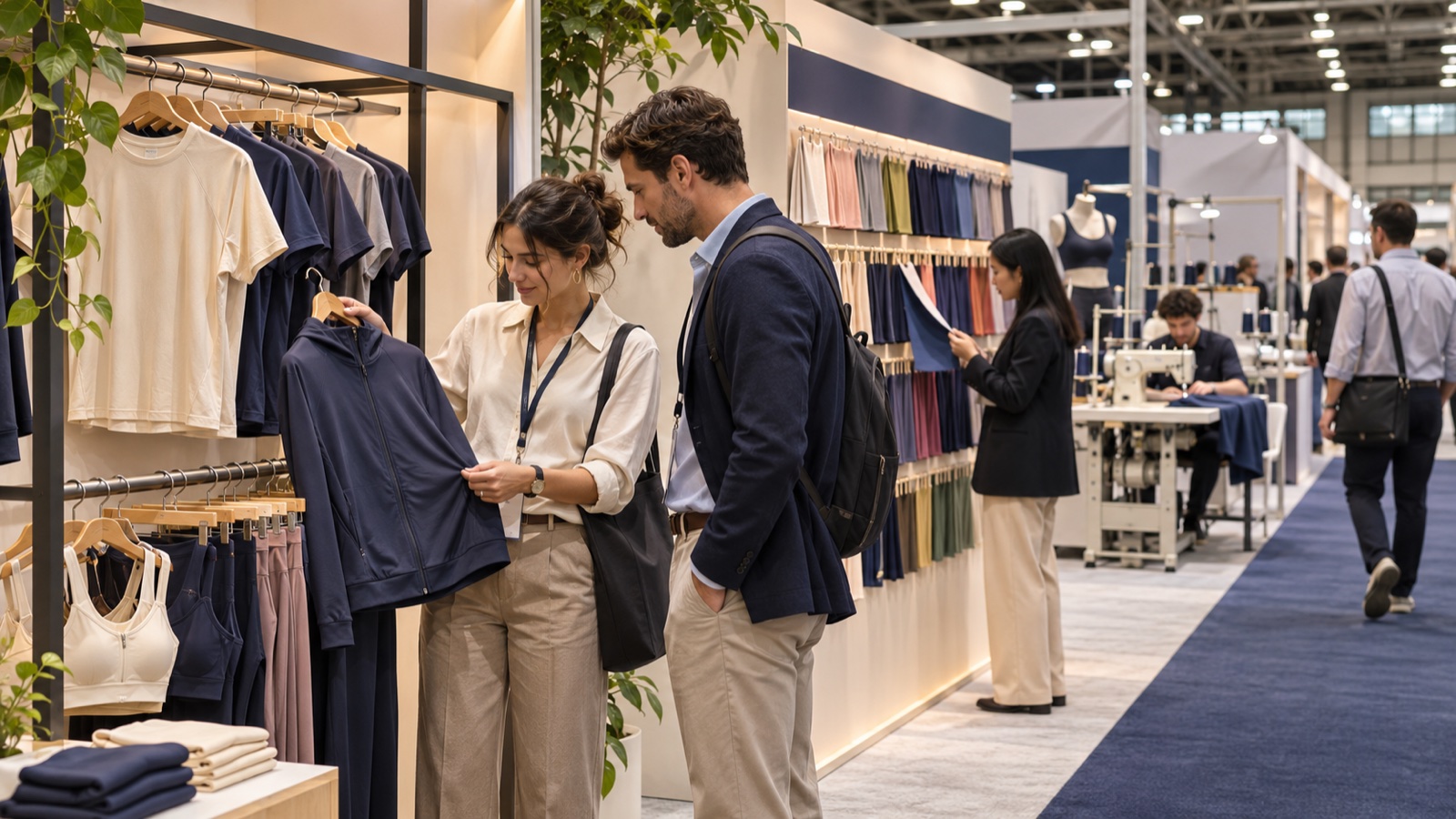
Read the exhibitor profile and actual exhibitor list before buying a ticket. A clothing brand seeking full-package production may find a machinery exhibition valuable for process knowledge yet unsuitable for its immediate factory shortlist.
- Finished-goods sourcing: look for manufacturers capable of the garment, materials and service scope you need.
- Material sourcing: use fabric, yarn and trim specialists to evaluate performance, handle, colour and development options.
- Machinery and technology: investigate sewing, cutting, automation, finishing and software with the people who will specify or operate them.
2026 Event Calendar and Official Portals
The dates below are retained as a 2026 sourcing record, checked November 5, 2026. Earlier editions have already ended. Follow the linked organisers for the next edition, registration and any updated schedule; a past date is not a current booking invitation.
Texworld NYC / Apparel Sourcing NYC
January 20–22, 2026 · New York · Past
Textiles and finished-apparel sourcing. Organiser’s 2026 announcement · Official portal.
Texworld / Apparel Sourcing Paris
February 2–4, 2026 · Paris · Past
International textile and apparel suppliers. Organiser’s dated release · Official portal.
Première Vision Paris
February 3–5, 2026 · Paris Nord Villepinte · Past
Material development and creative sourcing. Official visitor information.
SOURCING by Informa, Las Vegas
February 17–19 and August 10–12, 2026 · Past
Manufacturers, materials and sourcing services; also known through its SOURCING at MAGIC history. February date announcement · August event information · Official portal.
Texprocess Frankfurt
April 21–24, 2026 · Frankfurt · Past
Textile processing technology and machinery. Organiser’s event review · Official portal.
Canton Fair Phase 3
May 1–5 and October 31–November 4, 2026 · Guangzhou · Past
Broad finished-goods sourcing; confirm the apparel category and exhibitor location. 2026 official buyer attendance guide · Official buyer portal.
Asian International Apparel Sourcing / Asia Sourcing Show
June 3–5, 2026 · Bangkok · Past
Multi-country textile and apparel sourcing. Venue’s 2026 event listing · Official organiser portal.
ISPO Amsterdam
November 3–5, 2026 overall: Summit November 3; Expo November 4–5
Sports-industry connections, products and innovation at RAI Amsterdam. For booth sourcing, distinguish the Expo from the separate Summit. Official dates and access FAQ · Official portal.
ITMA ASIA + CITME
November 20–24, 2026 · Shanghai · Upcoming at this review
Textile machinery, rather than a dedicated finished-garment factory fair. Official timetable · Official portal.
7. Pre-Qualify Exhibitors and Plan Eight to Twelve Visits

Build an initial daily shortlist of 8–12 exhibitors. Leave time for walking, note capture and unexpected technical discussions. Use the organiser’s directory to check product scope, location, claimed processes and relevant audit information before scheduling.
Production-line, cutting-table and QC photographs are useful requests, but an office-only profile is not proof of trading status, and workshop photographs alone are not proof of ownership. Ask which entity operates the site and who will manufacture your order. Record how to verify each claim.
A meeting request should state three intended SKUs, the expected first-order volume—such as a 300-unit pilot—the target delivery window, and a direct question about the supplier’s manufacturing role. Request the technical contact’s attendance where the style requires it.
Use 9:30 a.m. as a possible early triage slot and 11 a.m. or 2 p.m. as examples for a pre-booked detailed review, subject to the actual show hours and booth schedule. Avoid relying on a late-afternoon walk-in for a complex discussion. Record the hall, aisle and booth in text—for example, 14.1 C 22—and save an offline map. Indoor positioning can be unreliable.
8. Prepare a One-Page Brief and a Controlled Full Tech Pack
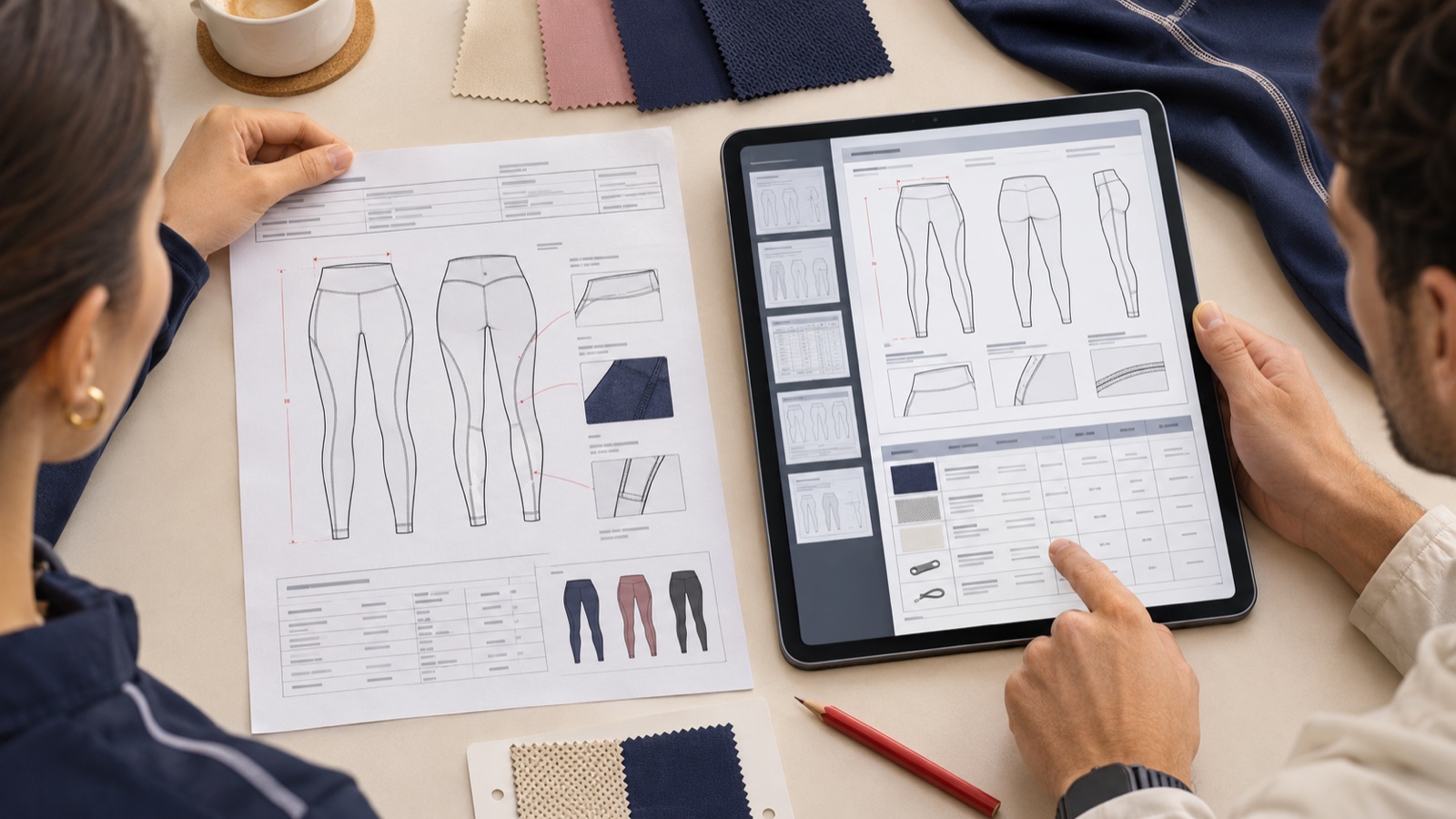
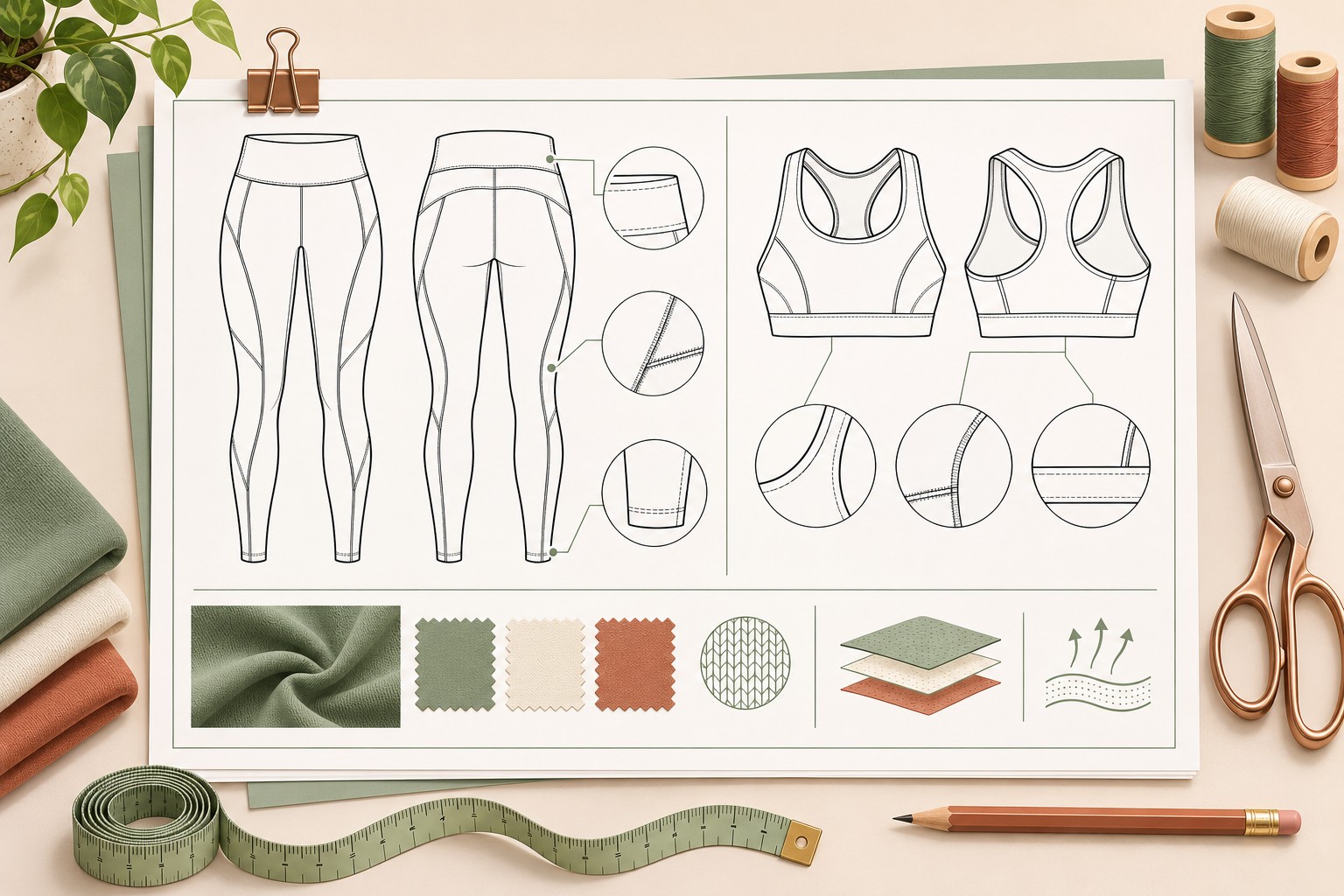
A 15-page technical file is hard to discuss in a crowded aisle. Bring a one-page physical brief and retain the complete digital package for qualified follow-up. The short version should expose the main cost and feasibility drivers without disclosing every development detail.
- Material: composition, target GSM range and performance expectations.
- Construction: relevant flatseam, bonding or other process requirements, with details clearly marked on the drawing.
- Identification: style code, revision, units and written part labels. Do not make the drawing depend on colour alone.
- Full package: graded POMs, tolerances, construction details, BOM, artwork, labels, packing and approval history, shared under appropriate project arrangements.
Use the Brief as a Feasibility Test
Ask which element is hardest to manufacture and what change would help meet your target. A proposal to move a seam 2 cm might improve marker efficiency in one design, but needs assessment against fit, appearance and performance before approval.
A marked-up brief is useful evidence of engagement. It is not conclusive evidence of ownership: a factory salesperson may need an engineer, and an experienced sourcing agent may have strong technical knowledge. Record the recommendation and obtain the responsible pattern team’s written response.
Our sportswear tech-pack guide explains what the full package should contain. Keep the same revision number across the booth brief and follow-up file.
9. Scan the Hall, Then Inspect Ordinary Samples
Allow a ten-minute hall scan to understand the layout before beginning the booked visits. A busy booth at 9:30 a.m. may be interesting, but crowd size can reflect position, promotion or a demonstration rather than production quality.
At a candidate booth, use a 30-second first screen. Compare several rack samples instead of relying on one display garment. Look at a Small and an Extra Large, checking whether seam execution and finishing remain consistent. A difference is a reason to investigate the size set, not a complete diagnosis.
- Extension and recovery: gently extend within an agreed range; note waviness, seam opening and delayed recovery. Do not yank a sample to destruction.
- Seam feel: inspect the inside surface and contact edges. Judge suitability for the intended activity and skin-contact zone.
- Decoration: look for visible cracking, transfer or surface damage. Ask what print process was used and which rub, wash or stretch tests apply.
- Zipper operation: open and close it three times to screen for catching, alignment and slider problems. This is not a life-cycle test.
Photograph labels and sample identifiers with permission, and record a 15-second voice note covering the contact, MOQ and lead-time assumption. Note texture and construction observations explicitly; exhibition lighting can distort colour. A garment label may identify a marketer or importer rather than the factory.
For movement-based assessment after buying a sample, use our activewear fit diagnosis guide. Save those findings with the sample code and supplier evidence record.
10. Ask the Same Ten Verification Questions
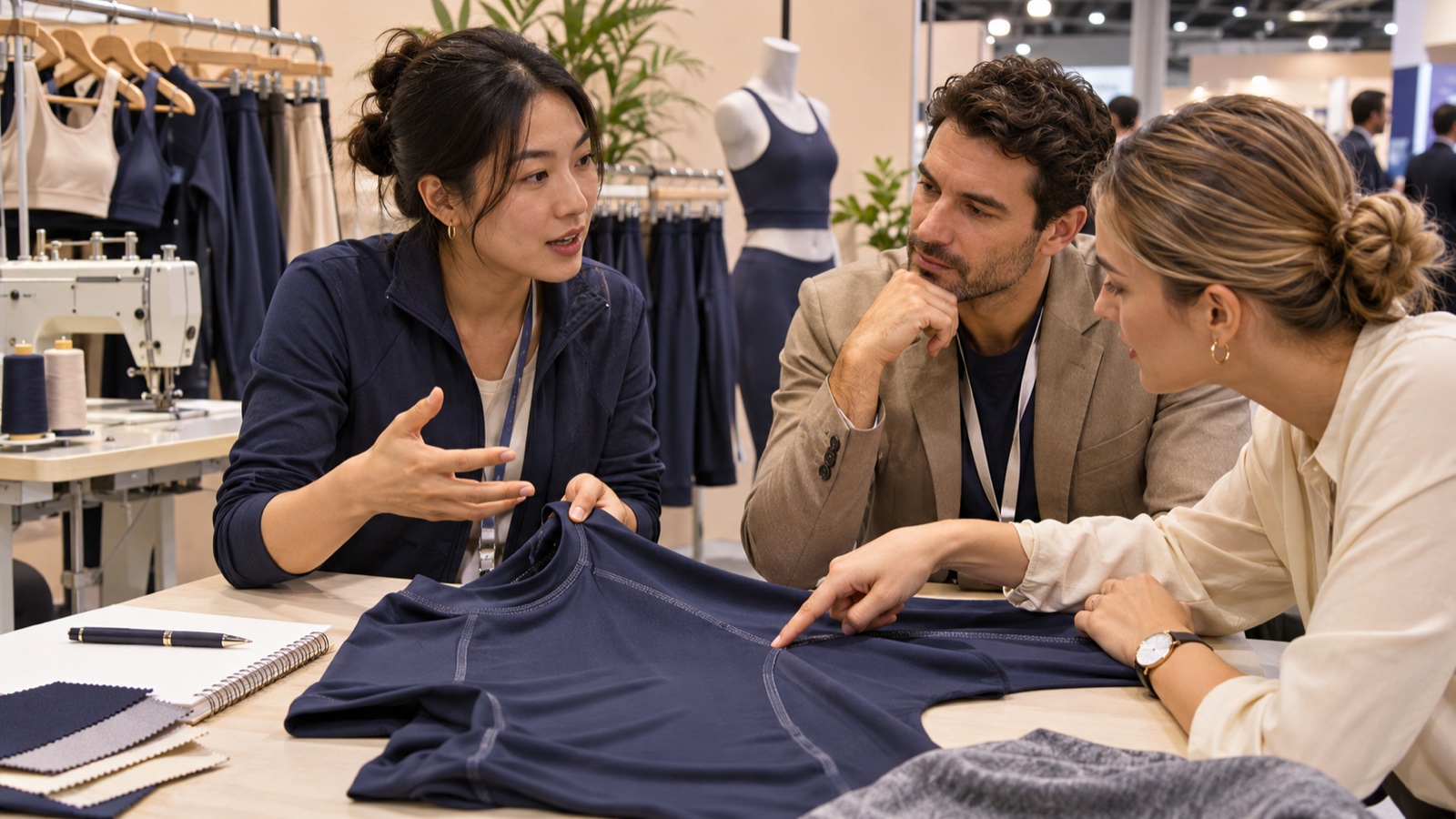
- Identity: what is the legal company name, manufacturing role and exact cutting/sewing site?
- MOQ: what is required per style, colour and size allocation, and what material commitment drives it?
- Sampling: what are the fees, lead time, revision scope and approval deliverables?
- Bulk timing: when does the clock start, what approvals are dependencies, and is this ex-factory or delivered?
- Process ownership: which cutting, sewing, printing, dyeing and packing operations are in-house or subcontracted?
- Quality: what inspection plan applies, including any proposed AQL 2.5 category, and can the buyer commission in-line and final checks?
- Assurance: which current site audits or certifications are relevant—such as amfori BSCI audit information, SMETA reports or WRAP facility certification?
- Market experience: which destination markets and comparable product requirements can the supplier substantiate?
- Evidence: can it share the relevant audit summary, certificate identifiers and corrective-action status through an appropriate channel?
- Pilot: what specification, payment, approval, inspection and ownership arrangements would govern a small first run?
A supplier quoting an example 45–60-day bulk window should explain its assumptions. A fast answer can still be wrong; an honest technical referral can be appropriate. Score specificity, evidence and consistency rather than response speed alone. The factory ten-question guide provides a fuller evidence-based interview.
With permission, obtain the business licence details and relevant audit summary. For China, retain the legal Chinese name and registration identifier, then check the National Enterprise Credit Information Publicity System. Commercial databases such as Qichacha and Tianyancha can supplement that check; they are not government registries.
11. Leave with an Action Record and a Booked Review

Return to strong candidates during a mutually agreed quieter slot. 9 a.m. or 4:30 p.m. may work at some events; neither is automatically open or quiet. A pre-booked 11 a.m.–2 p.m. meeting can work well even when the aisle is busy. Keep the discussion manageable and involve the right people.
- Identify owners: collect the commercial contact and the technical merchandiser or engineer responsible for the specification.
- Create a recap: record the style, quantity, material, quotation basis, unresolved questions, owners and dates. An example subject is Action Plan — [Brand] / [Supplier] / Style 123.
- Confirm receipt: ask the contact to check that the message arrived and correct any misunderstanding while you are together.
- Book the next review: propose a call 7–14 days after the show, with a clear agenda and agreed deliverables.
Sportxia’s tracking has found a 60% improvement in post-show response rates when the recap was sent during the booth conversation. Treat that as an observed result within our follow-ups, rather than a promised uplift for every trip.
Use two separate sample decisions: buy an existing display sample where useful for an early construction check, then commission a custom-specification sample to assess how the supplier interprets your file. Clarify what you own, what may be shared and what each payment covers. The factory search-to-first-PO guide connects these contacts to a broader sourcing decision.
12. Verify Two Finalists, Run Pilots and Lock the Calendar
Consolidate notes within 48 hours so questions and sample identities remain clear. Use one matrix for MOQ, sample cost, lead time and FOB or other agreed price basis. Preserve the original quote alongside your normalised comparison; currency, units, included services and delivery assumptions must remain visible.
Complete the Verification Gates
- Entity and payment: reconcile the contracting company, manufacturing site and beneficiary. Investigate and document differences before paying; group-company or trading arrangements require a clear explanation rather than an automatic assumption of fraud.
- Product and certificate scope: use OEKO-TEX Label Check and Textile Exchange’s certified-company directory. Check relevant transaction evidence as well as scope for recycled claims.
- Facility assurance: verify WRAP claims through its facility directory, and review the actual audit evidence for the other schemes applicable to the project.
- Process control: reconcile the live or independent site evidence with the production operations and subcontractors declared at the booth.
Choose two finalists for paid evaluation where the budget supports a fair comparison. Start with samples, then an agreed small pilot production run. Request a costed BOM or an agreed cost breakdown; confidential supplier costs may require an alternative format, but the quote scope still needs to be clear.
Inspect packing, barcodes, construction, measurements and performance separately. A crooked label can be a packing defect, yet it does not prove that the stitching is poor. For a specified 32 cm flat waist, a delivered 33 cm result is a one-centimetre difference: apply the agreed measurement method and tolerance before accepting or rejecting it.
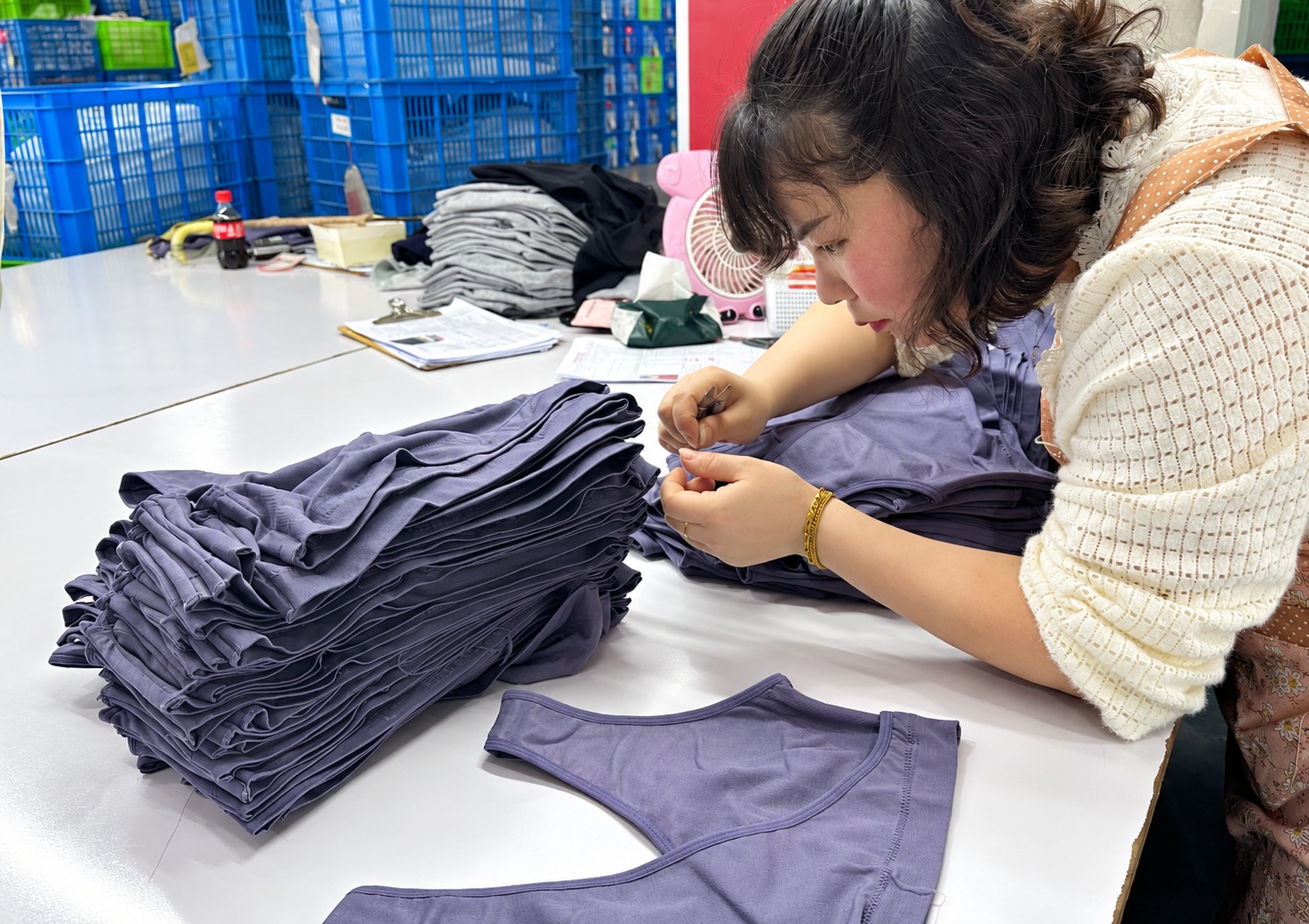
Record the approval path as sampling → pre-production sample (PPS) → bulk → QC → shipping, with owners, dependencies and realistic transit time. Use our sample-stage timeline to define what each gate must establish. Give the production decision to the supplier whose evidence, sample execution and communication meet the project requirements, rather than simply the first sample to arrive.
Troubleshooting Six Common Sourcing Failures
1. Every exhibitor claims to own a factory
Ask which operations and site the claim covers, who employs the workers and who controls subcontracting. Follow the legal registry check with a documented visit, live walkthrough or independent assessment. A willingness to receive a visit tomorrow is encouraging but not proof; scheduling constraints can be legitimate.
2. The supplier stops responding
Send the annotated brief, a dated sample plan and a short list of unresolved questions. Follow up through two agreed channels, such as email plus WeChat or WhatsApp. Sportxia has observed a 40% response-rate improvement with multi-channel follow-up. Use response quality and follow-through as selection inputs, while allowing for show workload and time zones.
3. The MOQ is too high
Identify whether the minimum comes from fabric dyeing, trim development, decoration or sewing. Ask whether stocked colours can be shared across styles and what material purchase remains payable. In an observed Sportxia negotiation, using market-stock colours instead of custom Pantones reduced the minimum from 1,000 to 100 units. That outcome depends on stock availability, style and capacity; it is not a blanket custom-production offer.
4. Bulk quality differs from the approved sample
Confirm the production site, approved material and construction before release. Retain a signed or sealed PPS reference and document the inspection plan, including any agreed AQL 2.5 defect category, inspection level and acceptance criteria. Commission independent inspection when appropriate. A golden sample supports comparison but cannot replace process and shipment checks.
5. Sustainability claims remain vague
Request the holder, site, certificate number, scope and product or material coverage. Verify the claim through the issuing scheme and reconcile upstream records with the actual garment route. Separate chemical-safety testing, recycled-content chain of custody and social audits; one does not stand in for the others.
6. You attended the wrong type of show
Rebuild the plan around the decision you need: a garment manufacturer, a material source or production technology. Keep the useful technical contacts, but do not treat a machinery distributor as a finished-garment OEM candidate just to fill the shortlist. Recheck the next event’s directory before booking.
Questions About Sourcing Sportswear Factories at Trade Shows
Can a 100-unit order work directly with a manufacturer?
It can, particularly where an approved stock-material or private-label programme fits the style. Sportxia’s standard starting point is 100 pieces, with 50-piece printed private-label options for suitable programmes. We have also used stock fabrics for 50-unit pilots. Confirm the exact product, colour/size split and service scope. Existing lawful stock can reduce dyeing commitments; it does not automatically allow use of another brand’s protected material or branding. Ask about a scheduled small production slot rather than assuming a named brand’s line is available.
Can one question instantly distinguish a factory from a middleman?
No single answer is conclusive. Ask about the machine and needle configuration for the proposed seam, and the fabric-relaxation method—whether a proposed 24 or 48 hours is appropriate for that material. Then verify the site, process control and legal relationships. A salesperson consulting an engineer may be acting responsibly. A transparent agent can also be useful when its role, fees and responsibility are clear.
Do I need a translator at Chinese trade shows?
Confirm the exhibitor’s language capability in advance. Large international fairs often offer substantial English-language access, but do not assume every booth or factory technician can discuss a complex specification in English. A bilingual technical interpreter can be valuable for detailed meetings and site visits. In one Sportxia conversation, explaining a gusset verbally took around 20 minutes; a dimensioned sketch made the requirement clear. Drawings, units and revision control reduce ambiguity in any language.
What is the biggest preparation mistake?
Arriving without a product specification and a defined cost basis. A target such as $9.50 DDP for a 280 GSM legging is a feasibility brief, not a realistic price guarantee. State the destination, quantity, required scope and who will handle import obligations; then ask which material or design changes could achieve the target lawfully. Compare the complete offer rather than treating a cheap headline as the decision.
Bring Home a Shortlist You Can Validate
A productive trip has a clear sequence: define the project, choose the event, pre-qualify, compare samples and evidence, capture the next actions, then test the finalists. Three genuinely qualified partners can be a useful trip objective, but the value depends on the orders and risk reduction they enable; attendance alone does not establish a financial return.
- Choose: one event whose exhibitor profile addresses your immediate sourcing need.
- Register: through the organiser’s portal and confirm access, dates and the intended meetings.
- Budget: allow for travel and an illustrative $500 pilot-sample budget, adjusting it for style complexity, freight, testing and the number of finalists.
- Document: use the same brief, evidence record and approval calendar from the first booth visit through the first PO.
If a two-week travel allocation does not fit your programme, a remote technical review is another starting route. Sportxia’s manufacturing services and cut-and-sew development can support a defined sportswear brief, with the same need for sample, scope and production approvals. Our planning ranges are 7–15 days for sampling and 15–30 days for bulk, subject to material availability, the agreed specification and approvals.
Send your tech pack and sourcing requirements to discuss the product, minimums, evidence and delivery plan before committing to a first order.
Reviewed November 5, 2026. Trade-show experience, response-rate improvements, response times and negotiation examples are company-reported. Event dates and access details link to organisers or venues; policy and assurance statements link to the relevant official sources. Generated trade-show scenes illustrate the workflow; the inspection photograph comes from the real factory library. Send a correction.
Related Posts

READY TO QUALIFY YOUR NEXT SPORTSWEAR SUPPLIER?
Turn Your Sourcing Brief into a Production Plan
Share your garment specification, quantities and delivery requirements. Agree the evidence, sample and approval steps before your first order.
Discuss Your Sportswear Project
Leave a Reply