CASE STUDY · TIME-CRITICAL EVENT APPAREL
Trade Show Success Case Study:
10,000 Custom Sportswear Units in 30 Days
 LucasUpdated November 3, 2026
Custom garments produced,
packed and delivered
From specification lock
to event-warehouse receipt
Critical defects found at final QC
ISO 2859-1 · majors AQL 2.5
Committed booth investment
supported by on-time apparel
Client Profile
| Industry | Corporate exhibitions and international events |
|---|---|
| Company size | Multinational business with 200+ employees |
| Location | US headquarters · international exhibition program |
| Event commitment | US$150,000 already committed to booth space |
| Starting challenge | 10,000 custom garments required within 30 days, against earlier lead-time quotations of 60–90 days and a fixed advance-warehouse receiving window. |
| Project brief | Reserved production capacity, in-line quality checks, consistent corporate colours, department-level packing and coordinated DDP air delivery before the receiving cutoff. |
The client, event and project personnel are anonymous. Production schedules, inspection records and freight timestamps may be reviewed in redacted form subject to client permission and a confidentiality agreement.
The Challenge
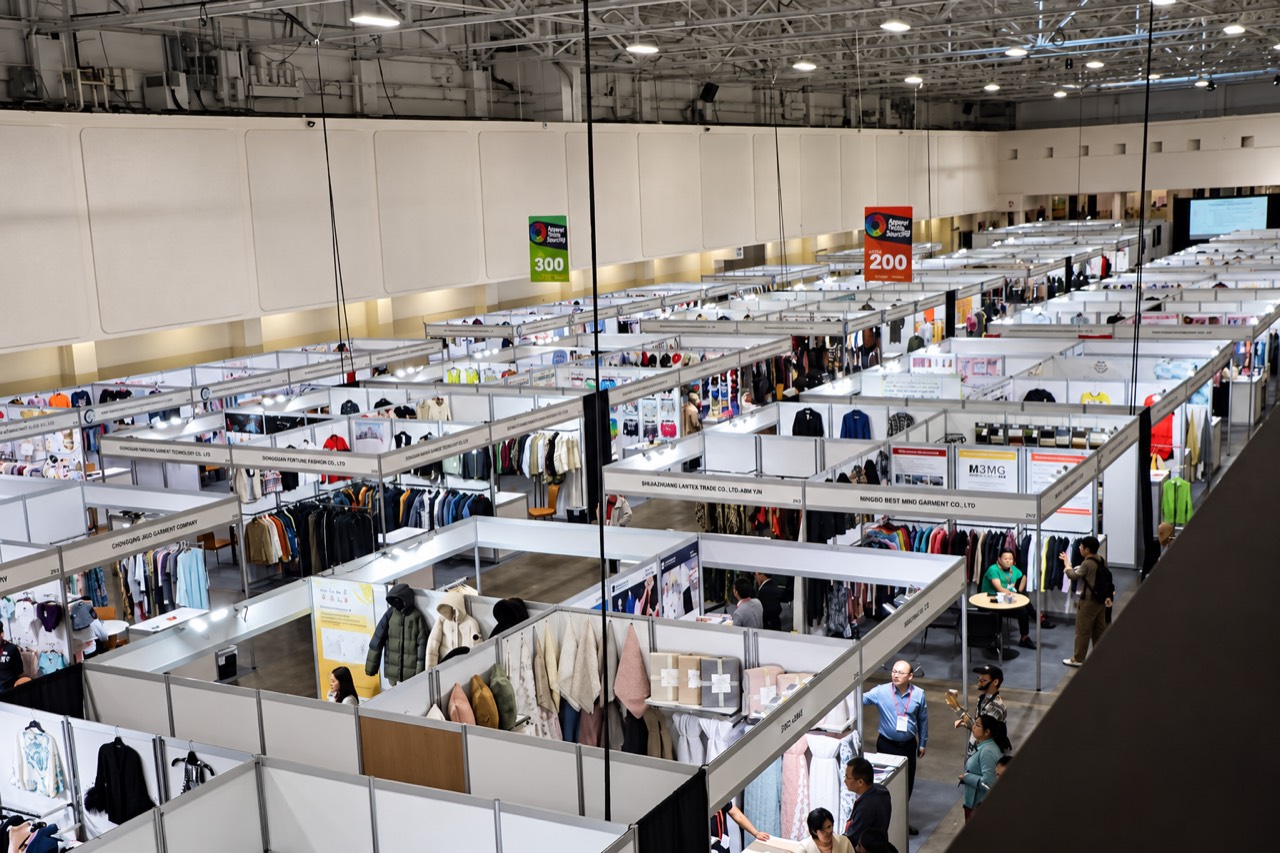
This trade show success case study began with an event date that could not move. The client had committed US$150,000 to its booth and scheduled customer meetings, but the custom garments still needed to be manufactured and received within 30 days.
Receiving at the event’s advance warehouse was the deadline. A carrier dispatch notice would not solve the problem if cartons reached the warehouse after its assigned window.
- The available time was shorter than the earlier quotations. The client had been offered 60–90 days for a comparable overseas order. Its event plan allowed one month for the specification, fabric, decoration, sewing, inspection, packing and delivery of 10,000 garments.
- The order included 12 style-and-size combinations. These covered the XS–4XL range, requiring an approved quantity matrix, graded patterns, cutting records and checks for the applicable combinations. The twelve combinations were not twelve separate size labels.
- The warehouse controlled when the freight could arrive. Cartons needed the receiving labels and routing information expected by the event’s material-handling team. Arrival outside the assigned slot risked rejection or a missed move-in sequence.
- Corporate colour had to remain consistent across the order. The client required its approved Pantone references to carry through printing and production. Visible variation between staff garments would undermine the coordinated presentation at the booth.
- A one-day delay would leave the event team unprepared. Even 24 hours mattered around the receiving cutoff. Locally sourced replacement shirts would not match the approved corporate collection or resolve the planned distribution by department.
The client had considered a promotional sourcing agent. Sportxia instead committed the production slots directly and reviewed the receiving requirements with the delivery team. For this order, the schedule reserved three dedicated flatlock lines.
The Solution
Sportxia planned the order as five connected delivery stages. The booked production lines, accepted fabric, quality gates and freight arrangements shared the same receiving deadline.
Days 1–3: Lock the Brief and Receiving Deadline
The team established the SKU and quantity matrix, size curve, artwork files and required arrival date at the start of the project. Core specifications were frozen on day one, and the written scope was confirmed within the first 72 hours.
Corporate Pantone references were checked against the digital colour standard within 24 hours. The accepted reference gave the print team a target and allowed production planners to reserve the necessary lines.
Receiving instructions were included with the manufacturing brief. The target was not simply to finish sewing by a date; it was to leave enough time for packing, air transport, clearance and the event-warehouse handoff.
Days 4–7: Reserve the Specified Fabric
The core garments used 160 GSM interlock polyester. The team reviewed its drape and coverage against the corporate garment sample and checked the selected polyester with the approved sublimation process.
Fabric was allocated through the established mill network while the event deadline and line booking were already fixed. The material lots were checked against the project’s OEKO-TEX® STANDARD 100 documentation, including the scope applicable to the supplied fabric.
Keeping the material lot, colour reference and garment specification together reduced the need to make late substitutions during the sewing window.
Days 8–22: Overlap Printing, Cutting and Sewing
The order moved in controlled batches through printing, laser cutting and sewing. The stages overlapped across three dedicated production lines, rather than waiting for the entire order to finish one operation before starting the next.
Four-needle flatlock construction followed the approved seam specification. Laser cutting used the accepted pattern files, with cutting and assembly checks maintaining the relationship between size labels, garment components and the order matrix.
A sleeve operation threatened the planned flow on day 18. Five cross-trained operators were reassigned from a secondary line and cleared the bottleneck within two hours. That intervention kept the affected batches moving within the booked production window.
The compressed schedule depended on the capacity allocated to this project and the ability to move trained operators when an operation slowed.
Days 23–26: Complete Quality Review Before Packing Release
In-line checks were already running during production. The days 23–26 window consolidated inspection findings and confirmed the finished garments before their release to packing.
- Print registration and logo position. The approved placement was three inches below the collar. The logo-position check was included for every garment.
- Seam construction and strength. Inspectors compared the sewn garment with the accepted construction reference while there was still time to correct an assembly problem.
- Size and label accuracy. Measurements and labels were checked against the approved style-and-size matrix before department-level packing.
- ISO 2859-1 sampling plan. The project set AQL 2.5 for major defects and a separate zero-acceptance rule for critical defects.
The final inspection recorded no critical defects found. This is the inspection finding reported for the project; AQL 2.5 is the major-defect acceptance parameter, rather than a claim that 2.5% of the order was defective.
ISO 2859-1 defines attribute-based acceptance-sampling schemes. The project’s inspection records identify the applicable plan and defect classifications.
Days 27–30: Pack for the Venue and Confirm Receipt
Cartons were separated by size and department, with prominent destination labels and the receiving information requested by the convention centre’s material-handling team. Packing followed the distribution list, so the event team could identify its garments without rebuilding the order at the venue.
The shipment used DDP express air delivery to the agreed receiving point. Transport, import-clearance documents and the applicable duties were coordinated within that arrangement; DDP did not remove customs checks.
The delivery record confirmed arrival before the advance-warehouse cutoff. This receiving timestamp completed the 30-day measure, linking the locked specification to the garments being available for the event.
The Results
Swipe or use the buttons to view every column.
| Measure | Requirement or earlier quotation | Project result |
|---|---|---|
| End-to-end project turnaround | Earlier quotations: 60–90 days | 30 days · specification lock to receiving |
| Custom garments delivered | 10,000 required for the event | 10,000 delivered |
| Style-and-size combinations | Approved quantity and grading matrix | 12 combinations covering XS–4XL |
| Critical defects at final inspection | Zero-acceptance requirement | 0% found in the final inspection |
| Corporate colour checks | Approved Pantone reference | 100% of measured checks met the approved colour standard |
| Event-warehouse arrival | Fixed receiving cutoff | Received before the cutoff |
| Booth-space commitment | US$150,000 exposed to apparel-delay risk | Apparel available on time for the planned event |
Measurement: production and shipment records support the delivered quantity and project schedule. Final inspection sheets record the critical-defect finding, while digital colourimeter readings support conformity to the accepted colour reference. Freight receiving timestamps were compared with the event warehouse’s assigned window. The US$150,000 figure is the client’s booth commitment, not a calculated financial return from the uniforms. Read Sportxia’s fact-checking process.
Key Takeaways
This trade show success case study connects the order scope, reserved production capacity, in-line inspection and the event’s receiving requirements:
- Freeze the order before booking a compressed schedule. For this project, the core brief was fixed on day one and confirmed within 72 hours. The 12 style-and-size combinations, approved artwork and receiving deadline gave the factory one release reference. A late alteration would have affected both the booked line time and the available delivery window.
- Use overlapping operations with capacity assigned to the order. Printing, laser cutting and sewing moved in batches across three dedicated lines. On day 18, five trained operators resolved a sleeve-operation bottleneck within two hours. The schedule relied on that specific allocation of machines and staff.
- Inspect while a correction can still reach the next operation. Logo placement at three inches below the collar, size accuracy and seams were reviewed during the production flow. Final release followed the major-defect AQL 2.5 plan and critical-defect zero-acceptance requirement. No critical defects were found at final inspection.
- Measure event delivery at the receiving point. The 30-day result ended when the warehouse received the cartons before its cutoff. Packing by department and size,clear receiving labels and coordinated DDP air delivery supported that handoff. A dispatch date alone would not establish that the uniforms were available for the event.
Redacted production schedules, inspection logs and freight timestamps may be available subject to client permission and a confidentiality agreement. Contact Sportxia to request the event apparel logistics file.
How Sportxia reviews manufacturing information and corrections: Fact-Checking Process. To report an error, email [email protected] with the article link and supporting information.
MORE CASE STUDIES
See More Case Studies
Custom Swimwear: A Shorter Sourcing Cycle
Ice Hockey Jerseys: Team Uniform Delivery
Corporate Activewear: A Coordinated Rollout
YOUR EVENT SPORTSWEAR PROJECT
Plan Your Event Apparel Delivery
Send your designs, quantities, event dates and warehouse receiving requirements. Sportxia will reply within 24 hours with the next steps for a quotation, samples and your production plan.
Discuss Your Event Apparel →