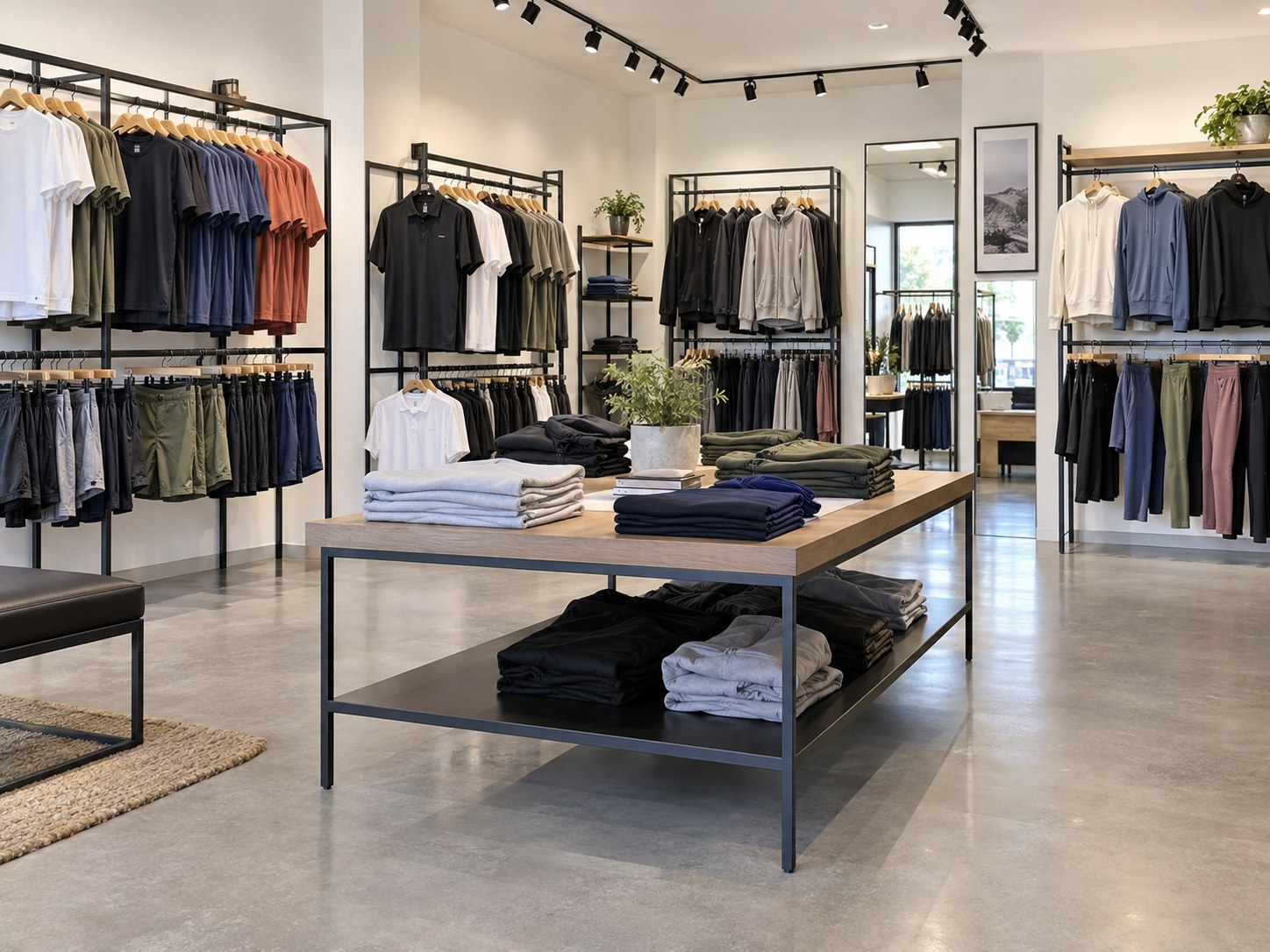
CASE STUDY · CUSTOM SPORTSWEAR REBRANDING
Sportswear Rebranding Case Study:
10 Product Categories
 LucasUpdated November 3, 2026
Product categories under
one master schedule
Custom items produced
across the collection
Defects found at
final inspection
Saved through freight
and delivery consolidation
Client Profile
| Industry | Corporate apparel brand undertaking a full rebrand |
|---|---|
| Company size | Mid-market business with 50+ employees |
| Location | United States |
| Product categories | Performance polos, outerwear shells, knit headwear, soft accessories, bags and five further categories |
| Starting challenge | A fixed launch date required ten categories to arrive together. The brand had been managing five or more suppliers, with inconsistent colour approvals, production updates and shipping dates. |
| Project brief | One coordinated manufacturing program, a shared production calendar and cross-material colour approval against the brand’s Pantone references. |
The client and project personnel are anonymous. Production calendars, redacted inspection records, colour-approval files and landed-cost breakdowns may be requested subject to client permission and a confidentiality agreement.
The Challenge
This sportswear rebranding case study began with a non-negotiable launch date. The US brand needed ten categories to reach its team in the correct quantities, with a consistent colour story and a single delivery plan.
For the preceding 18 months, the purchasing team had used five separate suppliers. Each worked with different dye houses, schedules and reporting formats. The team was reconciling five or more purchase-order trackers, shipment plans and quality reports.
Three problems made the fragmented arrangement unsuitable for the relaunch:
- The same brand navy looked different across materials. A Pantone reference approved for a cotton polo did not produce the same appearance on a synthetic outerwear shell. The opening project review recorded approximately 15% colour variance between the headwear embroidery thread and the shell fabric.
- Deliveries missed the shared launch window. In the previous season, knit headwear arrived three weeks early and created storage costs; outerwear shipped two weeks late. The brand spent US$6,800 on rush air freight to close the gap.
- Status chasing absorbed 12–15 hours each week. The operations team handled late-night supplier messages and updates in incompatible formats. Without a single calendar, it was difficult to see which approval or category threatened the launch.
The client first tried a shared spreadsheet for its existing suppliers. Within two weeks, an unannounced dye-lot change disrupted the agreed colour palette. A common tracker could not resolve separate production decisions, so the new brief called for one governed manufacturing program.
The Solution
Sportxia replaced separate category plans with one coordinated program, connecting shared components, colour approvals, the production calendar and final delivery through four phases.
Phase 1: SKU Rationalization and Standardization
Sportxia brought the 15,000 items across ten categories into one program. The first review identified shared components and grouped the work by material family, allowing the production team to reduce repeated purchasing and preparation tasks.
- One matte-black zipper-pull specification served outerwear and accessories, removing the need for two separate trim orders.
- One polybag specification across all ten categories gave packaging a common supplier brief and a consistent quality checkpoint.
- Material-family planning grouped knitted, woven and coated products for efficient preparation and cutting rather than treating every finished category as an isolated job.
The approved component list established a common reference before category-specific details were finalized. This kept a change to a shared trim or packing item visible across the collection.
Phase 2: Cross-Substrate Color Lock
The same Pantone code can appear different on cotton, nylon, polyester and embroidery thread. Sportxia reviewed the lab dips concurrently under D65 daylight conditions in a controlled light box, placing the polo knit, outerwear fabric and headwear thread together for comparison.
The project used a 5% review threshold: a reported variance above that level triggered reformulation before bulk production. On day two, the team caught the approximately 15% mismatch between the headwear thread and outerwear material. Adjusting the shell dye formulation brought the recorded variance below 3%.
An estimated US$40,000 in mismatched outerwear inventory was avoided. This was the client’s estimate of the inventory exposed to the colour problem before the correction, separate from the realized US$12,000 landed-cost saving.
The colour review used common lighting and approved physical standards, consistent with the purpose of AATCC’s guidance for visual assessment of textile colour differences. The percentages above are the project’s reported comparison figures; they are not ΔE values or AATCC grading levels.
Phase 3: Synchronized Production Calendar
Sportxia planned backward from the launch date. The 45-day outerwear allowance anchored the program, while earlier-finishing products were held for the combined dispatch rather than sent as separate partial shipments.
The complete category schedule retained the planned lead time, actual production result, inspection method and landed-cost allocation:
Swipe or use the buttons to view every column.
| Category | Planned | Actual | Quality result | Landed cost | Coordination note |
|---|---|---|---|---|---|
| Outerwear shells | 45 days | 42 days | Pass · AQL 2.5 | US$5,200 | Shipped with knit headwear |
| Performance polos | 30 days | 30 days | Pass · AQL 2.5 | US$3,100 | Shared polybag specification |
| Knit headwear | 25 days | 25 days | Pass · 100% in-line inspection | US$1,500 | Held at dispatch for the outerwear |
| Soft accessories | 20 days | 18 days | Pass · final random inspection | US$2,200 | Zipper pulls matched the shells |
| Remaining six categories | 20–35 days | On time or early | All passed | US$5,000 combined | Consolidated into the same FCL shipment |
Total landed cost: US$17,000 across the ten categories. The recorded earlier comparison was approximately US$29,000. The US$12,000 saving reflected the combined effect of eliminating rush charges, additional warehousing and fragmented shipments.
The headwear was held at dispatch to join the completed outerwear. All ten categories then moved in one full-container-load (FCL) shipment, giving the launch team a single delivery plan.
Phase 4: Quality Lock and Delivery
A single QA program followed the shared production schedule. During the outerwear run, the inspection team identified a small tension variation on the first batch of Juki sewing machines. The line paused for recalibration, and the affected batch was reviewed and cleared within 45 minutes.
The category checks remained visible in one file: AQL 2.5 for the shells and polos, 100% in-line inspection for the headwear, final random inspection for soft accessories and recorded approval for the remaining categories. The final inspection recorded zero defects. This finding applies to the inspected project lot and does not guarantee a zero-defect rate for future orders.
The client’s operations lead reviewed the consolidated delivery and highlighted the reduction in separate status reports. Instead of chasing the ten category updates independently, the launch team worked from one master calendar and one dispatch plan.
The Results
Swipe or use the buttons to view every column.
| Measure | Before · fragmented sourcing | After · coordinated program |
|---|---|---|
| Supplier relationships managed | Five or more | One coordinated manufacturing partner |
| Cross-material colour variance | 15%+ in the project comparison | Below 3% after correction |
| Category delivery performance | Three of five categories late | All ten on time or early |
| Rush freight expense | US$6,800 | US$0 |
| Total landed cost | Approximately US$29,000 | US$17,000 |
| Defects at final inspection | Earlier rate not tracked | 0% found at final inspection |
| Administration time | 12–15 hours per week | Below 2 hours per week |
| Launch delivery | Staggered arrivals | One unified launch-day collection |
Project records: the comparison draws on the client’s earlier procurement and shipping records, the new production calendar, category inspection reports and the landed-cost breakdown. The US$40,000 figure is an estimate of inventory exposure avoided; the US$12,000 figure is the recorded reduction in total landed cost. Read Sportxia’s fact-checking process.
Key Takeaways
The lessons from this sportswear rebranding case study concern the decisions that connect ten product categories to a shared launch:
- Approve the colour set across materials, together. A shared Pantone code did not prevent the earlier 15% mismatch. Reviewing thread, polo knit and shell fabric under the same D65 conditions allowed the team to correct the shell formulation before bulk production and bring the recorded variance below 3%.
- Standardize common components before optimizing each product. The matte-black zipper pulls and shared polybag specification reduced separate purchasing tasks and made the collection easier to inspect. Grouping the 15,000 items by knitted, woven and coated material families connected the development decisions to the production plan.
- Plan backward from the slowest category. The 45-day outerwear allowance anchored the calendar; actual shell production finished in 42 days. Holding completed headwear for the same dispatch supported one coordinated launch, with all ten categories on time or early.
- Evaluate the complete delivered cost of the program. The US$12,000 saving came from the combined shipping and delivery changes, including the removal of US$6,800 in earlier rush freight. Consolidating into one FCL reduced the costs of separate shipments and storage while administration fell from 12–15 hours to below two hours per week.
The production calendar, redacted colour-approval reports, inspection records and landed-cost breakdown may be reviewed subject to client permission and a confidentiality agreement. Contact Sportxia to request the rebranding project file.
How Sportxia reviews manufacturing information and corrections: Fact-Checking Process. To report an error, email [email protected] with the article link and supporting information.
MORE CASE STUDIES
See More Case Studies
Custom Swimwear: A Shorter Sourcing Cycle
Ice Hockey Jerseys: Team Uniform Delivery
Corporate Activewear: A Coordinated Rollout
YOUR BRAND RELAUNCH
Coordinate Your Next Brand Launch
Send your product categories, artwork, colour references, quantities and launch date. Sportxia will reply within 24 hours with the next steps for your quotation, samples and coordinated production plan.
Discuss Your Brand Relaunch →