How to Calculate Your Clothing Sample Cost: A Step-by-Step Budgeting Guide
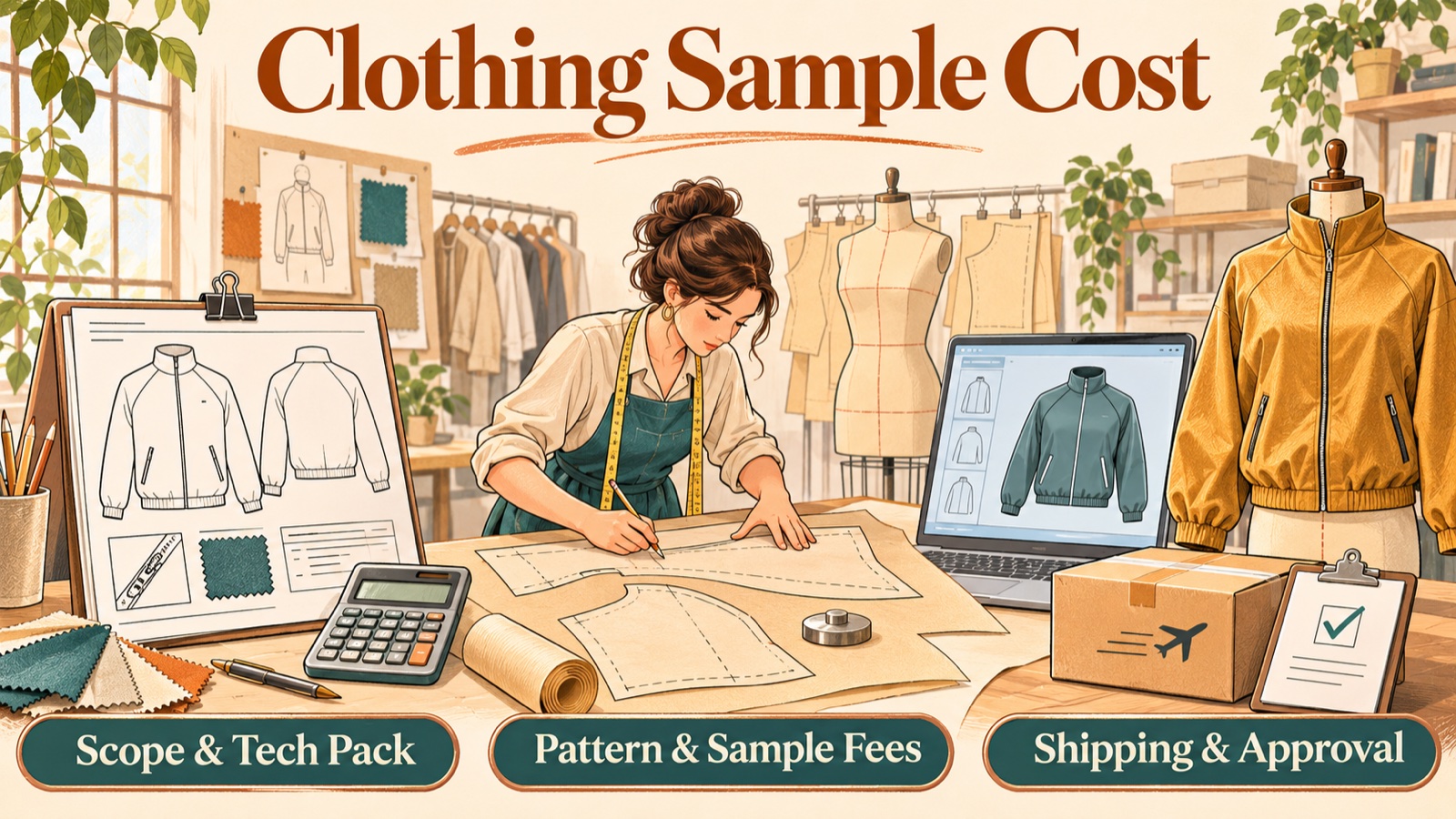
Separate development work, sample-making and delivery costs before you commit. Budget each approval round instead of multiplying a bulk unit price.
A prototype pays for decisions that a bulk garment no longer needs: the pattern, machine settings, material selection and fit corrections. Treating that engineering work as an ordinary unit purchase leaves a gap in your launch budget. A hoodie prototype can reach three times the target manufacturing price once pattern digitising, setup and international delivery enter the calculation.
At Sportxia, we start by defining the question each sample must answer. This guide shows how to calculate clothing sample cost from the first brief through the physical pre-production approval. Plan for one to three revision rounds, with separate allowances for sample fees, logistics and any testing your product requires.
Use a documented size basis and points of measure rather than relying on a size letter. A recognised body-measurement reference can support the starting block, but the finished-garment specification, ease and tolerances still need agreement for your customer and fabric. Every uncertain input is another potential development charge.
What You Need Before You Request a Quote
Preparation: approximately two hours. Difficulty: intermediate. In Sportxia’s experience, around 80% of sample delays have involved missing information in the initial brief. A phrase such as “relaxed fit” is a direction; a measurement chart and reference garment turn it into a task a technician can price.
1. The Decision Checklist: Documents
- A physical reference garment: use a lawfully obtained reference to communicate drape, proportion and hand feel. Identify which features are relevant without asking the factory to reproduce protected branding or artwork.
- Target specifications: define the market, size range—for example, US women’s XS–XL—and required fabric performance. A 280 GSM nylon/spandex proposal needs a composition, structure and performance specification; weight alone cannot establish squat-proof opacity.
- A landed-cost ceiling: work backward from the selling model. For a $60 retail price, a $12–$15 landed-cost target is a useful planning example, not a universal margin rule. Include duties, freight and other costs relevant to your channel before choosing a premium material.
2. The Toolkit
Set up a costing sheet with separate columns for pattern work, sample-making, custom hardware or moulds, testing and courier charges. Keep bulk unit prices on another line. Use a phone camera and annotation software to mark the exact seam or measurement that needs attention. If the project uses CLO or another 3D tool, include the editable project and the fabric assumptions used in the simulation.
3. Roles and Responsibilities
Name the person who owns the tech pack, the person who approves fit and the person who authorises extra spending. If you supply only a reference garment, allow for technical documentation and pattern development rather than assuming these are free. Our technical designer versus fashion designer comparison explains which role translates the design into manufacturing instructions.
4. Safety and Compliance
Include label development and applicable testing in the sample budget. For US-bound apparel, the FTC’s apparel-label guidance covers fibre content, country of origin, responsible-business identification and care instructions under the relevant rules. Confirm the requirements for your actual product and destination before label approval.
Agree the production inspection plan separately from sample approval. If using AQL 2.5 for a defect class, also specify the sampling standard, inspection level, lot definition and acceptance criteria. It is neither a product certification nor a promise that every shipment has exactly 2.5% defects. Sample QC establishes whether the design works; bulk inspection assesses consistency against the approved reference.
5. A 2026 Development-Budget Snapshot
The following ranges are starting allowances for quote comparison, not independently surveyed market averages or a fixed Sportxia tariff. Currency is USD. Confirm the exact scope, country, complexity and delivery basis with live quotations.
| Expense | Freelance pattern maker (US/UK) | Factory-inclusive route (China/Vietnam) |
|---|---|---|
| Pattern creation | $50–$150/hour planning range | May be included or waived for qualifying bulk orders over 500 units; confirm scope |
| Cut-and-sew sample labour | Separately charged; $100+ per sample example | A bundled sample fee may be $50–$200; confirm what is included |
| Revisions | Hourly work can apply to each change | One round may be included; confirm correction versus design-change rules |
| Source-file ownership | Agree DXF/PDF release and rights in writing | Factory retention is possible unless release and ownership are agreed |
How to Calculate Your Clothing Sample Cost
Use this structure: one-time development + all chargeable sample rounds + material and decoration setup + testing + all shipments and import costs + contingency. Record conditional bulk-order credits separately. They reduce the eventual net development spend only when you meet the written conditions; they do not remove the cash needed now.
Step 1: Write a One-Page Scope Brief
Freeze four variables before asking for a price: garment complexity, customisation level, material certainty and branding scope. Standard leggings and a multi-panel jacket require different development work. An existing-block adjustment differs from a fully custom pattern. A selected fabric code is a different task from open-ended sourcing.
State whether this round needs final prints and labels or only a blank fit sample. For a complex silhouette, a digital prototype may resolve proportion questions before physical cutting. Write the single risk the round must remove: sleeve mobility, waistband height or panel balance is more actionable than “check quality.”
What a useful scope produces
An item such as “pattern adjustment: $50” explains a deliverable. A “sample package: $500” may also be valid, but ask what it includes before comparing it with an unbundled offer. Use written labels such as “Fit scope” and “Fabric scope”; colour-coded spreadsheet columns alone can be misunderstood.
Step 2: Create a Factory-Ready Tech Pack

A finished sketch does not resolve seam construction or measurement. Choose whether to prepare the documentation yourself, hire a technical designer or request factory development support. Our sportswear tech-pack guide describes the specifications needed for a repeatable quotation.
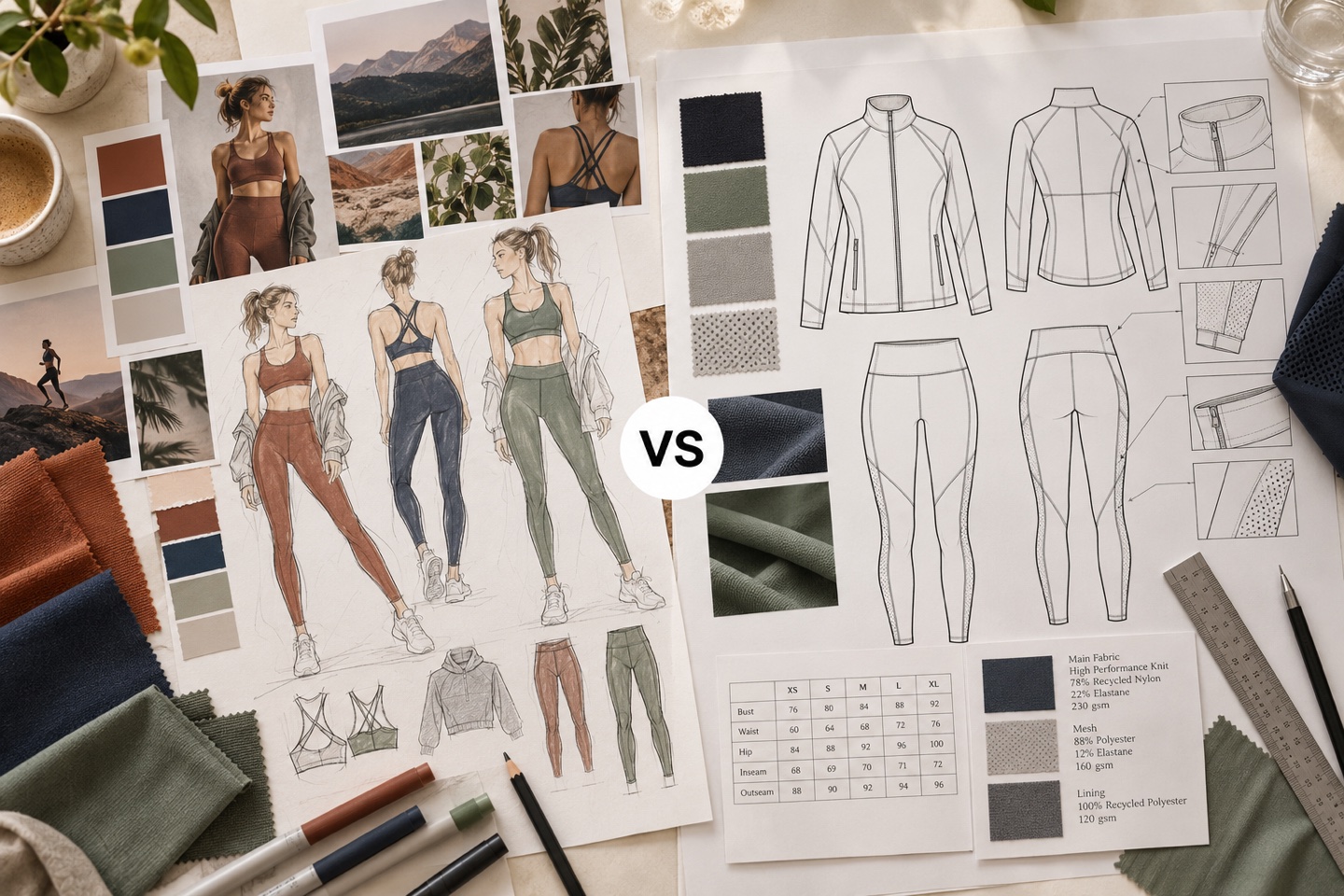
- Technical flats: show front, back and construction details, identifying flatlock, overlock and other required seams.
- Bill of materials: list the fabric code, composition, weight, colour, elastic, zippers, labels and trim specifications.
- Points of measure: define dimensions, units, measurement method, size basis and tolerances.
- Revision allowance: a 15% documentation/versioning reserve can be an initial budgeting assumption. Adjust it to the actual development contract.
Count colourways, print positions and seam complexity before submitting the file. Print processes, embroidery setup and packaging requirements can each introduce separate setup work.
Sportxia has found that interpreting an ambiguous sketch can take around three times longer than working from a clear tech pack. A firm quote tied to a specific revision is the goal. Sensible material or construction questions from the factory are useful evidence of review, so a quick quote without questions is not by itself proof that the scope is complete.
Step 3: Separate Pattern Fees from Production Costs

Choose the pattern route and the file-release terms together. A freelance route may be budgeted at $60–$150 per hour, while a factory may bundle pattern work into a flat development fee. Neither payment method automatically determines intellectual-property ownership. The agreement must state source-file ownership, access, permitted reuse and release conditions.
Ask for three deliverables separately: the base pattern draft, size grading and the marker used to arrange pieces efficiently. DXF or PDF files can help with portability, but confirm file format, grading data and compatibility rather than assuming every file is ready for a different factory.
| Component | Freelance route | Factory bundle |
|---|---|---|
| Drafting allowance | $80–$150/hour for this scope | $50–$200 flat-fee example |
| Revisions | Additional billable hours as agreed | Often one round included; define scope |
| File ownership and release | 100% ownership only if agreed; specify editable DXF delivery | May remain with factory unless the agreement grants rights and release |
These narrower drafting allowances cover a different scope from the broad preparation table above. Do not add both tables as if they were separate charges. Request a written breakdown of the work included, any hourly cap and the number of revisions.
Step 4: Build a Staged Sampling Roadmap
Give each gate an owner and acceptance criteria. Match payment releases to the agreed contract and progress. One attractive prototype is not enough evidence to authorise bulk production.
- Prototype: check the construction approach; record any substitute material.
- Fit sample: assess proportion and movement on the intended body basis. Allow for at least two fit rounds where development risk justifies it, within or beyond the initial one-to-three revision plan.
- Size set: check grading at relevant sizes; an XL requires more than enlarging a medium uniformly.
- Pre-production sample: approve the final bulk fabric, trims, construction and decoration. Retain this controlled “golden sample” as the production reference.
Perform a Sensory Check
When substitute fabric changes to the bulk material, reassess stiffness, drape, surface friction and comfort. A slick or spongy hand can affect handling and seam behaviour, but tension settings need actual sewing trials rather than a simple universal rule. Stiffer material may change perceived ease enough to require pattern adjustment.
Enforce Measurable Tolerances
An agreed ±0.5 cm tolerance at selected critical points can be a project requirement; do not apply it indiscriminately to every measurement. A target such as greater than 90% stretch recovery likewise needs a test method, extension, cycles and recovery time. Specify those conditions before comparing results.
See the clothing sample-stage timeline for the approval sequence. Digital checks can remove roughly two weeks of shipping time in a suitable hybrid workflow, but a render cannot establish touch, wash performance or final physical fit. Keep the physical pre-production gate.
Step 5: Request an Itemized Quote Package
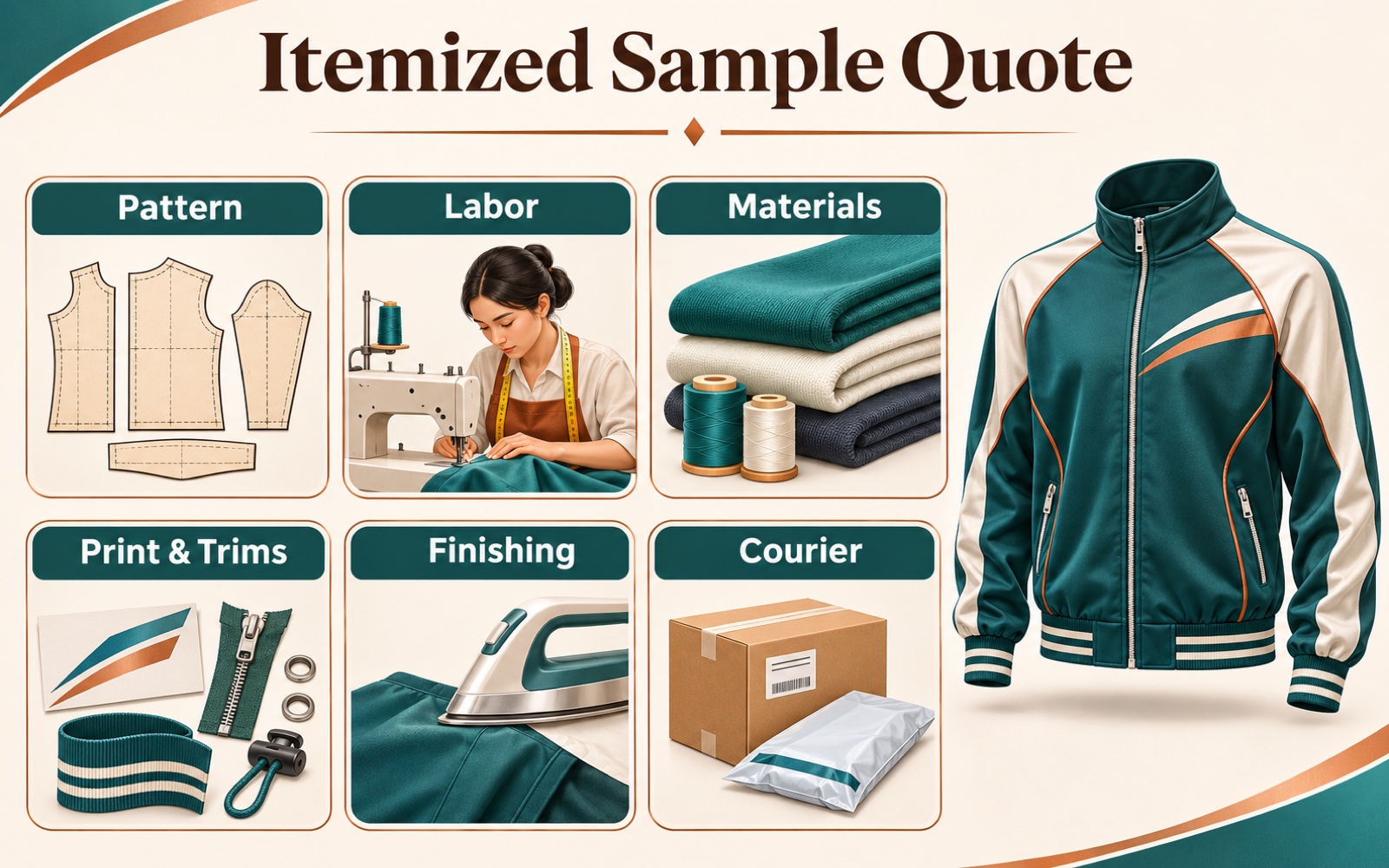
Send the controlled tech pack, BOM and material specification together. Ask whether each charge is one-time, per style, per colour or per round. A single-unit technician’s labour can be budgeted at two to three times the bulk labour rate; this is a labour comparison, not the same as comparing complete sample and bulk unit prices.
- Pattern and digitising: separate initial creation, grading and later changes.
- Cut-and-sew labour: include manual cutting, machine setup and sample-room work.
- Materials: identify small-yardage surcharges, sourcing and trim minimums.
- Decoration and finishing: list screens, embroidery digitising, custom labels, washes and any tooling.
- Logistics: state courier service, destination, named delivery basis, customs responsibilities and exclusions.
A ready-to-use quotation request
Please quote the attached tech pack revision [date/version] for [style, quantity and destination]. Show pattern/digitising; sample labour; fabric and trim sourcing; print/embroidery setup; wash/finishing; and air courier charges separately. State lead time, included revision scope, charges for buyer changes, responsibility for correcting nonconforming work and reshipment costs. If quoting DDP, identify the named destination and import arrangements. Please confirm pattern-file release and any sample-fee credit conditions.
Sportxia’s applicable programmes can include one revision round and sample-fee credits of 50%–100% against qualifying bulk orders of 300–500 units. The written quote must identify the programme, eligible charges, threshold, timing and exclusions. These credit thresholds are distinct from our usual 100-piece starting MOQ.
Ask for a dated schedule tied to approved inputs and material availability. Our planning range is 7–15 days for sampling, subject to the agreed specification and approvals. A detailed quotation makes comparison easier; unwillingness to itemise requires clarification, but is not proof of hidden subcontracting or dishonesty.
Step 6: Create a Per-Round Logistics Budget
Price the complete approval route rather than one outbound parcel. A project can involve two to three shipments across prototype, fit and pre-production review. Use actual packed dimensions and weight; a planning allowance might start at 0.5 kg for an activewear top or 1 kg for a hoodie, with packaging adding approximately 200 g. Couriers may use dimensional weight, so a light but bulky box can cost more.
Express planning often assumes 3–5 transit days, but the service, destination, clearance and operating calendar determine the actual estimate. Obtain a live DHL quotation or FedEx rate estimate. Include fuel and remote-area charges where applicable.
Under a properly agreed DDP arrangement, the seller takes the specified delivery and import-clearance obligations, including relevant duties and taxes. Confirm that the arrangement is workable for the destination. EXW leaves much more collection and onward responsibility to the buyer; it may suit an established logistics operation, but it is a different scope, not a like-for-like cheaper delivery.
Calculate the reserve explicitly
For equal-rate parcels: courier rate × three shipments × 1.20. At an illustrative $50 per parcel, $150 plus a 20% contingency is $180. If routes or weights differ, total each shipment before applying the reserve. Keep duties or testing outside the formula unless included in the quoted rate.
Sportxia has observed savings of around 40% when consolidating multiple suppliers’ samples into one shipment instead of three separate envelopes. Compare the actual combined parcel and handling charge, and do not delay a critical approval merely to fill a box.
Step 7: Apply the 3D-versus-Physical Decision Rule
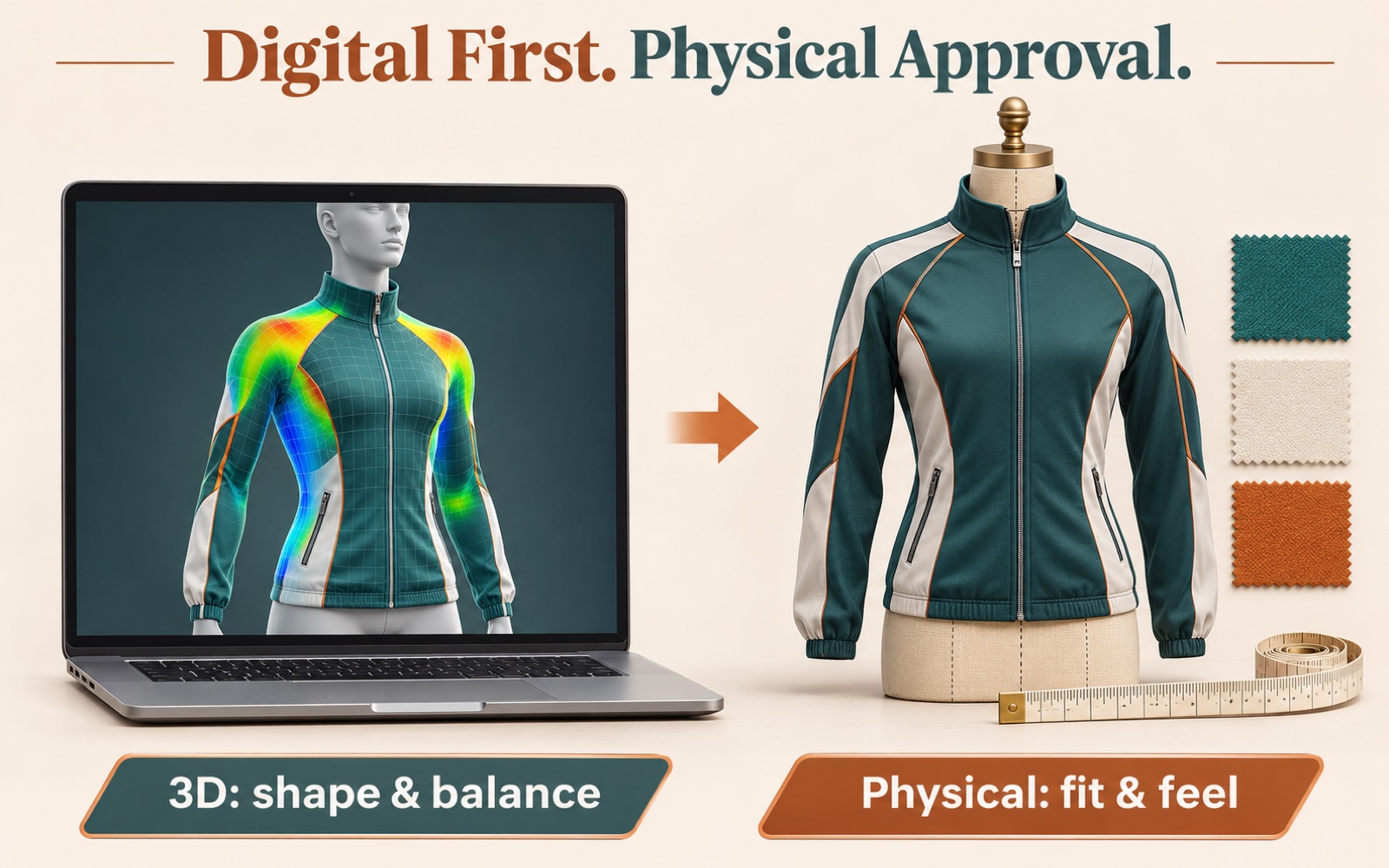
Use digital sampling where panel balance, silhouette and repeated proportion changes drive the risk. CLO and Browzwear are relevant tools. A Sportxia digital seam adjustment has taken about 15 minutes where the corresponding physical remake required approximately five days; complexity, queue and file readiness change that comparison.
Review the tension or strain map and investigate concentrated red zones. Simulation depends on avatar, pattern and material inputs; colours on a screen are not a laboratory result or a physical fit approval. Prioritise a physical sample when compression, rebound, surface feel, acid-wash treatment or another material property is central to the product.
- Digital budget: pattern conversion, calibrated material inputs, asset creation, simulation, rendering and revisions.
- Physical budget: material sourcing, cutting and sewing, decoration, testing and courier.
- Digital deliverables: agree the editable project file, such as a CLO .zprj, the avatar/size basis and measurement chart.
- Physical deliverables: receive the actual sample, its material identifiers and the relevant inspection record.
A useful hybrid path is to complete the first two fit iterations digitally when appropriate, then make the physical pre-production reference. Scope this with the development team; it is not suitable for every fabric or construction. Our manufacturing services and cut-and-sew support provide the starting discussion for a project-specific route.
Step 8: Run the Technical and Sensory Audit
Inspect on a flat surface as well as on the intended wearer. Record each result against the current tech pack rather than approving from a mirror impression.
- Measure: use the defined POM method and identify deviations beyond the agreed threshold, such as 0.5 cm at a specified point.
- Check seams: extend them under the intended movement. Cracking, skipped stitches or tunnelling require investigation into stitch configuration, tension, thread and fabric compatibility.
- Assess grain and twist: fold sleeves and legs to identify torque. Cutting alignment, fabric skew, construction and laundering can contribute; diagnose before prescribing a remake.
- Screen recovery: an informal five-inch extension and release can reveal waviness. Record the starting gauge length and conditions; this is not a standardised recovery test or proof that elastane alone is at fault.
- Wash: use the intended care procedure and inspect shrinkage, shade change, bleeding and print adhesion. Record pre- and post-wash measurements.
Create the Revision Brief
Use annotated photos with a defect ID, actual measurement, target, proposed action and responsible person. Update the source measurement chart and BOM, issue a new version and ask the factory to acknowledge it. A photograph in an email does not replace a changed specification.
Retain a physical PPS using final bulk materials and trims before production release. Use our activewear fit diagnosis guide to investigate recurring construction or fit symptoms, then discuss the sample and production plan with the team responsible for the order.
Troubleshooting Common Sampling-Budget Failures
In Sportxia’s experience, around 90% of sampling-budget overruns have involved unclear requirements or uncontrolled changes. Use the following checks to identify the missing cost or approval step.
1. The quote is three times higher than expected
Separate one-off moulds, patterns and setup from repeated labour. Ask whether a 500-unit bulk order qualifies for a credit; applicable Sportxia programmes can credit 50%–100% under the agreed terms. Use a stock zipper for an early fit round if it can answer the technical question, then approve custom hardware at the final stage.
2. Every round introduces new issues
Replace conversational corrections with one controlled change log. Circle the defect, specify the target measurement, update the tech pack and distinguish a new design request from correction of work that missed the existing specification. Agree which party pays for each category before the next round starts.
3. Medium fits, but XL does not
Review grading and body assumptions rather than repeatedly remaking the medium. A simple +2 cm increment may not suit every location. A jump-size set such as XS, M and XL can expose problems before bulk. Define point-specific tolerances and remedy terms in the contract.
Keep units consistent: ±0.5 inch equals ±1.27 cm, not ±0.5 cm. ASTM D6193 concerns stitches and seams; it does not set a universal garment-measurement tolerance. Choose the tolerance for the product and measurement method rather than citing the wrong standard.
4. Shipping consumes the budget
Repeated single-item parcels can attract a substantial minimum charge; $40 per parcel is a planning example, not a universal courier rate. Consolidate five or more non-urgent review items where practical, or use a qualified forwarder. Compare handling, dimensional weight and the time cost of waiting.
5. The factory agrees, then uses the wrong fabric
Review every BOM line and attach a swatch card to the sample. Record the fabric code, composition, weight, colour and approved substitutions. Ask the factory to confirm those identifiers explicitly. A general acknowledgement does not resolve which material has been approved.
For children’s apparel, include the applicable product-safety assessment and testing before launch. The CPSC’s children’s-product guidance is the starting point for US requirements. Assess lead, applicable phthalate restrictions, flammability, tracking/certification and drawstring rules for the specific product and components; requirements and exemptions are not identical for all textiles.
People Also Ask About Clothing Sample Cost
How much does a clothing sample typically cost?
For early planning, a custom cut-and-sew sample may be allowed $50–$300, depending on scope. A simple T-shirt might be budgeted at $80, while a technical waterproof jacket can exceed $400. An illustrative $50 courier allowance is separate unless included. These examples are not a fixed Sportxia price list; confirm patterns, material sourcing, decoration, tests and delivery in the written quote.
Can the sample fee be refunded or credited?
Sportxia offers applicable programmes with 50%–100% sample-fee credit for qualifying 300–500-unit bulk orders. Confirm eligible fees, quantity basis, timing and exclusions in the initial quote. Credit against a bulk balance is different from an unconditional cash refund. Our standard 100-piece MOQ does not automatically qualify an order for this credit.
Build a Budget That Survives the Approval Process
Sampling is a sequence of risk-reduction decisions. Start with a controlled brief, pay for defined deliverables and keep enough cash for revision, physical verification and shipping. Ask two or three suppliers for comparable itemised estimates before committing.
- Collect: the reference garment, size basis, tech pack and landed-cost target.
- Choose: which questions can be resolved digitally and which require physical material.
- Approve: fit, size set and final PPS through recorded gates.
- Lock: the BOM, patterns, revisions and commercial terms before bulk release.
Learn about Sportxia’s sportswear manufacturing and the product-development process before selecting your route. Our planning ranges are 7–15 days for sampling and 15–30 days for bulk, subject to material availability, the agreed specification and approvals.
For a sourcing shortlist, compare the sportswear manufacturers in China. To distinguish who supplies the design and who develops the manufacturing specification, discuss the proposed scope through our development and manufacturing services. Use the designer-role guide when assigning responsibility for the technical package.
Send your tech pack and sample requirements for a quotation with defined costs, revision terms and production milestones.
Reviewed November 16, 2026. Operational experience and anonymous cases are company-reported. Budget ranges are planning examples; applicable commercial terms must be confirmed in a written quotation. Regulatory and technical references link to official sources. Images illustrate the development workflow. Send a correction.
Related Posts

READY TO BUDGET YOUR FIRST SAMPLE?
Turn Your Brief into a Costed Development Plan
Share your style, fabric, quantity and destination. Agree the sample scope, revision allowance and approval route before production.
Discuss Your Sample Project
Leave a Reply